ploughs.farmyard.im
Horse plough, tractor plough — and steam ploughing?
Official museum wording keeps those as different kinds of work. A mouldboard turns the soil. A photograph of a ploughing match is not a typical working day. The desk below stays with the official sentences.
Open a topic
What a mouldboard is for
In the Museum of English Rural Life’s 51 Voices essay “Ploughs and Progress,” the medieval plough is described as the Festival of Britain model that showed the earliest form of ploughing in that display. The essay says: “The most significant technological advancement in ploughing during this period was the addition of a mouldboard, which represented a major improvement on the more ancient ard.” Of that example it then says: “These cumbersome types of plough turned the soil and buried the weeds and were drawn by domesticated animals such as oxen.” [source]
That official wording is about a type of medieval plough with a mouldboard, drawn by oxen. It is not treated here as a description of every later horse plough, tractor plough or set of steam ploughing equipment.
Horse ploughing
The same 51 Voices essay says that Joseph Foljambe’s Rotherham swing plough “was more refined and efficient, taking less power and effort for the horse to pull it through the field. These factory-produced wooden machines were the starting point for mass-produced metal ploughs, drawn by horses.” [source]
The MERL catalogue record for object 52/102, a Wiltshire plough, names it as a horse plough and a swing plough. The description says it “has a wooden mouldboard, asymetric handles, and an iron ploughshare.” The official record uses the spelling “asymetric.” A museum note adds that this plough “was used in a live demonstration of horse ploughing during the World Ploughing Championships in Shillingford, Oxfordshire, in 1956,” and that the Museum’s exhibition at that event “was largely concerned with tractor ploughing.” [source]
Horse ploughing and tractor ploughing are therefore kept as two official kinds of work, even when they appear at the same championship.
A tractor plough
The MERL catalogue record for object 79/68 describes a “Lister-Cockshutt No. 6, 2 furrow tractor plough,” made in 1936 by the Cockshutt Plow Co., Brantford, Ontario, used at Low Farm, Hemingfield, Barnsley, and imported to the UK by R. A. Lister & Co. of Dursley, Gloucestershire. [source]
The official label text says: “Tractor plough. Manufactured in Ontario and imported to the UK in around 1940, this tractor plough was then used at Low Farm, Hemingfield for the next 40 years. By this time, internal combustion engines had become the dominant force in British ploughing. The mass-produced Fordson tractor was more compact and efficient than steam ploughing equipment, and faster than horse ploughing. It was also cheaper than either of these options.” [source]
That official sentence names three distinct things: a tractor, steam ploughing equipment, and horse ploughing. They are not mixed here into one machine.
Steam ploughing equipment
The official MERL tractor-plough label quoted above mentions “steam ploughing equipment” as something the Fordson tractor was “more compact and efficient than.” [source]
Steam ploughing equipment is therefore present in the official wording, and it is kept distinct from a horse plough and from a tractor plough. It is not treated here as the same object as object 79/68, and it is not folded into the horse-plough story. A later farmyard site on traction engines is planned for steam traction engines and cable ploughing in more detail.
Multiple furrows, and a debate
The 51 Voices essay says later horse-plough designs “led ultimately to the culmination of plough design in the tractor-drawn, multiple-furrow ploughs of today. Today, of course, there is much debate about the mixed benefits of ploughing and there is a move towards minimal tillage systems.” [source]
That official “today” wording is a museum essay, not a Defra statistical release, and it is not treated here as a numbered official total.
A match is not a typical day
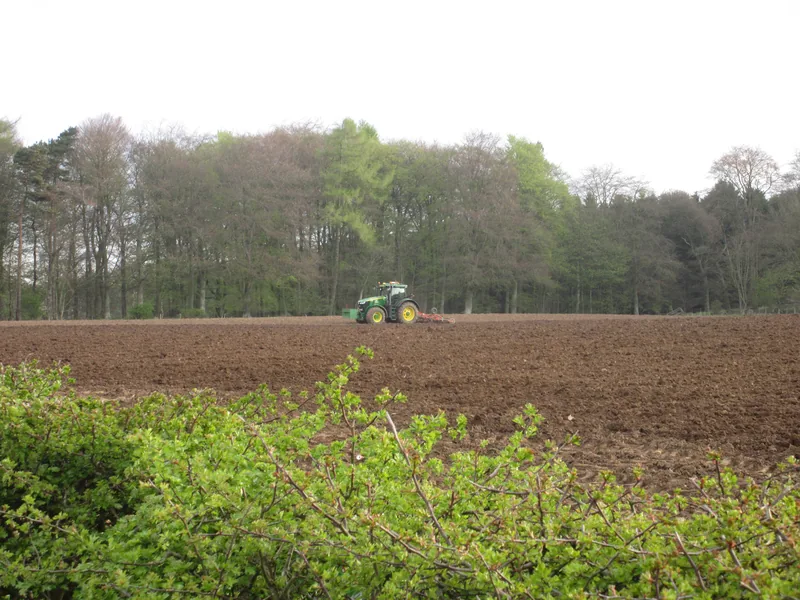
Photographs on this site show tractor ploughing in named fields, a Muir Hill tractor and a Ransomes reversible plough with spectators watching, horse ploughing at a 2011 ploughing match, and a balance plough at the 2016 World Ploughing Championships. A ploughing match, and a championship display of steam ploughing equipment, are not presented here as typical commercial days, and they are not museum object records.
Three questions
1. In the official MERL 51 Voices wording, what did cumbersome medieval ploughs with a mouldboard do?
2. The official MERL label on the Lister-Cockshutt tractor plough says the mass-produced Fordson tractor was more compact and efficient than what, and faster than what?
3. The MERL note on the Wiltshire horse plough says the Museum’s 1956 exhibition at the World Ploughing Championships in Shillingford was largely concerned with:
Enjoyed the furrow?
No pop-ups. No intrusive advertising. Just interesting stuff. A little support helps the next farmyard site get built.