Home · Facts
Facts, kept in their official boxes
- Official MERL wording says the addition of a mouldboard was a major improvement on the more ancient ard, and that cumbersome medieval ploughs of that type “turned the soil and buried the weeds and were drawn by domesticated animals such as oxen.” [source]
- The Rotherham swing plough, in the same essay, “was more refined and efficient, taking less power and effort for the horse to pull it through the field,” and factory-produced wooden machines of that kind “were the starting point for mass-produced metal ploughs, drawn by horses.” [source]
- MERL object 52/102 is a Wiltshire horse swing plough with a wooden mouldboard and an iron ploughshare. A museum note says it was used in a live demonstration of horse ploughing at the 1956 World Ploughing Championships in Shillingford, where the Museum’s exhibition “was largely concerned with tractor ploughing.” [source]
- MERL object 79/68 is a Lister-Cockshutt No. 6, two-furrow tractor plough, made in 1936, used at Low Farm, Hemingfield, Barnsley. [source]
- The official label on that tractor plough says the mass-produced Fordson tractor was “more compact and efficient than steam ploughing equipment, and faster than horse ploughing.” [source]
- The 51 Voices essay says later designs led to “the tractor-drawn, multiple-furrow ploughs of today,” and that there is “much debate about the mixed benefits of ploughing and there is a move towards minimal tillage systems.” That is museum wording, not a Defra statistical total. [source]
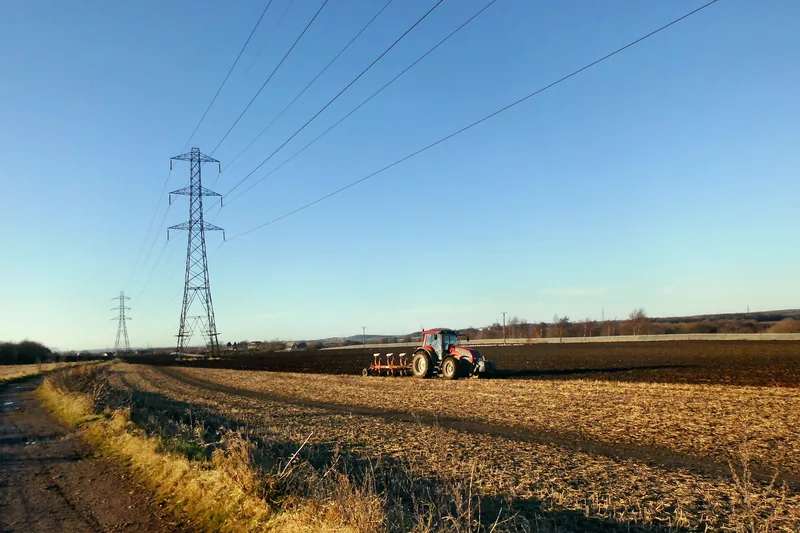
The photograph above shows tractor ploughing at Wheldale Lane, Castleford, in January 2018. It is included as a clear, freely licensed picture of that work, and is not a MERL object record.
Enjoyed the furrow?
No pop-ups. No intrusive advertising. Just interesting stuff. A little support helps the next farmyard site get built.