Discoveries
Things you may never have been told about the plough
A champion from Cornwall, a set of Festival models with one still unlocated, a plough named for a crooked foot, and a Canadian implement that arrived because someone wanted cream separators. Each story is still attached to its source.
A wooden plough at a tractor-age championship
In 1956, at the World Ploughing Championships in Shillingford, Oxfordshire, champion ploughman Nelson Tamblin of Liskeard, Cornwall, demonstrated a Wiltshire horse plough with a wooden mouldboard. The Museum of English Rural Life’s marquee exhibition at the same championships “was largely concerned with tractor ploughing.” A photograph of the demonstration is archive number 60/1475. [source]
West Tuelmenna Farm, bought in 1921
The Tamblin family farmed West Tuelmenna Farm, near Liskeard. His father had bought it in 1921. In May 2015 the Museum confirmed the ploughman’s first name, Nelson, with his great-nephew Rob Tamblin and his nephew Roger Tamblin. The farm, the family and the first name are all in the official object history, not later colour added on top. [source]
Eight model ploughs on the South Bank
A set of scale-model ploughs was made for the Festival of Britain in 1951 and shown in the Country Pavilion on the South Bank Exhibition site in London, under the Festival themes of “Land” and “People.” The set included a seventeenth-century Hertfordshire plough, a caschrom, a breast plough, a medieval plough, an eighteenth-century Hertfordshire plough, a Rotherham plough, a Kent plough and a Ley plough, “alongside examples of modern tractor technology.” [source] [source]
Two withdrawn, one unlocated, five still intact
After the Festival, the newly formed Museum of English Rural Life acquired the models. The Kent plough and the Ley plough “were later withdrawn from The MERL collection.” The whereabouts of the eighteenth-century plough “are not currently known,” and the Museum “holds no record of it having been disposed of or withdrawn.” Madeleine Ding writes that “the other five models still survive intact,” and that at least one surviving example “was sent on loan to the Science Museum at some point in the past.” [source]
A crooked foot, for ground a plough could not reach
The caschrom, or foot plough, takes its name from the Gaelic for “crooked foot.” It was wooden, “especially for use in rocky soils where ploughs could not go, or perhaps by people who could not afford a plough.” Such tools “were used mainly in the Scottish Highlands, but similar tools were also found in Ireland and Norway.” [source]
A plough pushed from the chest
The breast plough was “an early type of manual plough or turf-lifting device, that sliced off and removed the top layer of soil.” A T-shaped horizontal bar at the handle end “pushed against the worker’s chest or thighs,” with a triangular blade at the other end, “one side bent up to a vertical position.” These ploughs “were in common use until the early-twentieth century for paring turf, levelling ground, and clearing land of stubble.” [source]
The Rotherham, before industrialisation
Jonathan Brown, honorary fellow of The MERL, “has suggested that the Rotherham plough may be considered the pinnacle of plough design before industrialisation.” The refined swing plough, “with tapered share, coulter, and mouldboard reduced draw weight and therefore created a more efficient plough than earlier versions.” [source]
A butterfly that turns at the headland
Richard Hornsby & Sons of Grantham made a one-way reversible, or “butterfly,” plough around 1900. Two mouldboards sit on a swivelling beam: one in the furrow, the other in the air. At the end of the furrow the ploughman released a catch and the beam turned over. The firm had begun as Seaman and Hornsby, at Spittlegate Ironworks, in 1815, and by the end of the nineteenth century employed 1,500 people on a 17-acre site. [source]
A cream-separator deal brought a Canadian plough to Yorkshire
The Lister-Cockshutt No. 6 was made in 1936 by the Cockshutt Plow Company of Brantford, Ontario, and imported by R. A. Lister & Co. of Dursley under a reciprocal agreement: Lister imported Cockshutt ploughs, and Cockshutt imported Lister cream separators. This example, originally red, was used at Low Farm, Hemingfield, Barnsley, and bought at auction when the farm was sold on 30 May 1979. [source]
Cheaper than steam, and cheaper than horses
The official MERL label on that plough says: “The mass-produced Fordson tractor was more compact and efficient than steam ploughing equipment, and faster than horse ploughing. It was also cheaper than either of these options. It worked on the same principle that the Ford Model T had used to dominate the motor car industry; that an everyday person should be able to afford one.” [source]
Two engines, and a plough between them
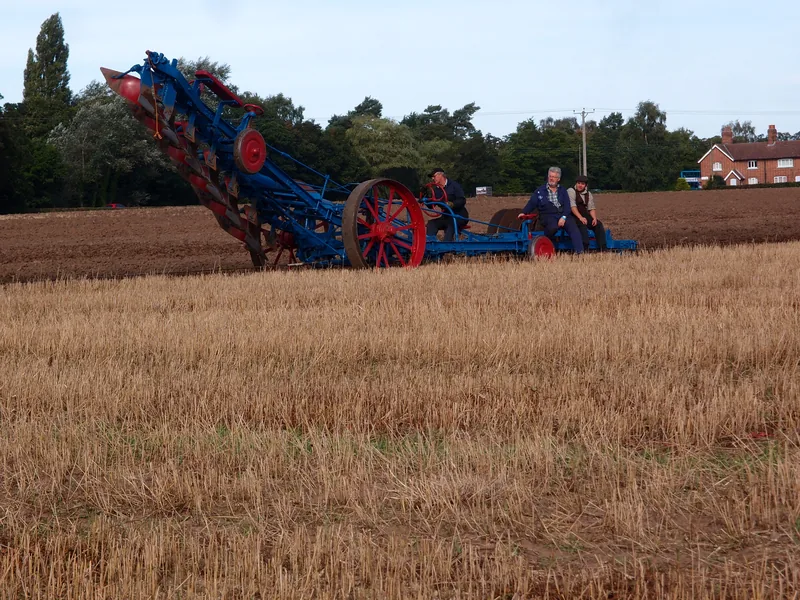
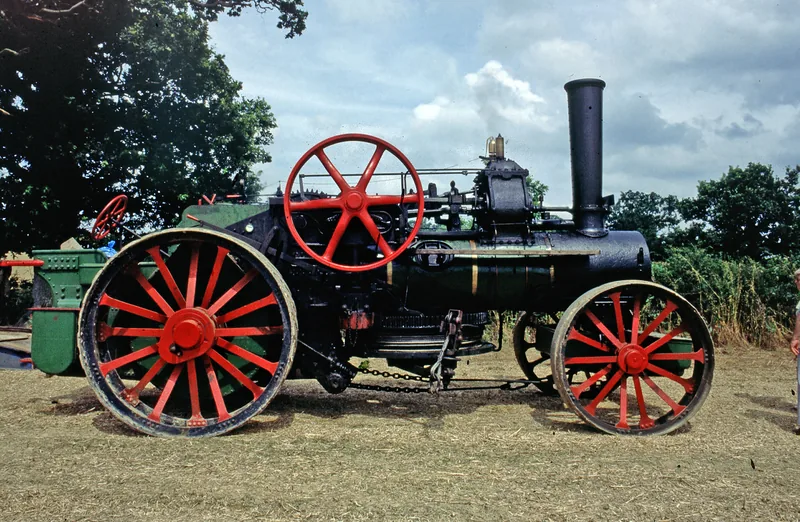
Steam ploughing was accomplished with two engines, one at each side of the field, winching the plough to and fro on a cable. A mid-1980s photograph of a Fowler engine at Staplehurst in Kent, by Les Chatfield, still shows the machine that did one half of that work. A balance plough at the 2016 World Ploughing Championships at Crockey Hill shows the other half, still demonstrated long after steam left ordinary commercial fields.
Major and Drummer take a break
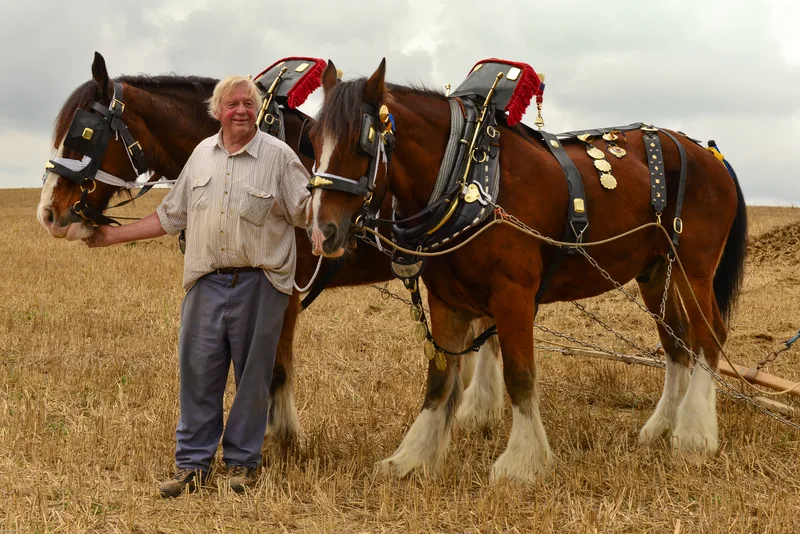
At an East Sussex ploughing match on 29 September 2014, Winniepix photographed two horses at rest with their ploughman. The file names them: Major and Drummer. The exact parish is not named. The picture is a reminder that horse ploughing is not only a museum story. It still has named animals, and a rest between bouts.
Enjoyed the furrow?
No pop-ups. No intrusive advertising. Just interesting stuff. A little support helps the next farmyard site get built.