Questions
Questions people actually ask
Short answers, in official wording where an object or a life is concerned.
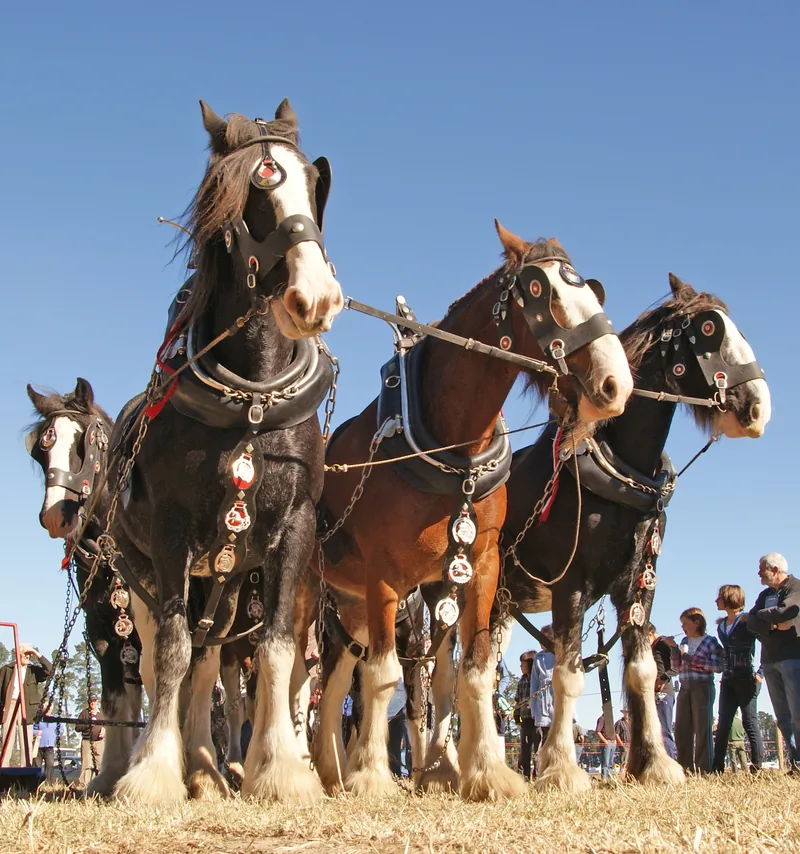
Who was Nelson Tamblin?
A champion ploughman from Liskeard, Cornwall, who demonstrated the MERL’s Wiltshire horse plough at the 1956 World Ploughing Championships in Shillingford. The family farmed West Tuelmenna Farm, bought by his father in 1921. [source]
Was the 1956 championship only about horse ploughing?
No. The Museum’s own exhibition there “was largely concerned with tractor ploughing.” The horse-ploughing demonstration happened in that setting. [source]
What was a caschrom for?
It was a wooden foot plough, named from the Gaelic for “crooked foot,” used mainly in the Scottish Highlands “in rocky soils where ploughs could not go, or perhaps by people who could not afford a plough.” Similar tools were also found in Ireland and Norway. [source]
What was a breast plough?
A manual turf-lifting tool, pushed from a T-shaped bar against the worker’s chest or thighs, with a triangular blade. In common use until the early twentieth century for paring turf, levelling ground and clearing stubble. [source]
What is a butterfly plough?
A one-way reversible plough with two mouldboards on a swivelling beam. At the end of the furrow a catch is released and the beam turns over. The MERL example was made by Hornsby of Grantham around 1900. [source]
Why did a Canadian plough end up in Barnsley?
R. A. Lister of Dursley imported Cockshutt ploughs, and Cockshutt of Brantford, Ontario, imported Lister cream separators. The MERL’s No. 6, made in 1936, was later used at Low Farm, Hemingfield, and bought at the farm sale on 30 May 1979. [source]
How did steam ploughing work?
Usually with two engines, one at each side of the field, winching the plough to and fro on a cable, rather than driving the engines themselves up and down the furrows.
Did the Fordson simply replace the horse?
The official MERL wording is broader: it was “more compact and efficient than steam ploughing equipment, and faster than horse ploughing,” and “cheaper than either of these options,” on the Model T principle “that an everyday person should be able to afford one.” [source]
Are all the Festival of Britain plough models still in the museum?
Not all eight. The Kent and Ley models were later withdrawn. The eighteenth-century plough cannot currently be located. Madeleine Ding writes that the other five still survive intact. [source]
Can I use the photographs in the free downloads?
No. The free fact sheets are typographic only. CC BY-SA photographs are used on the website only.
Is this a museum website?
No. It is part of farmyard.im and the ReallyByte network, run by REALLYBYTE, based in the Isle of Man. Official wording is quoted from published Museum of English Rural Life catalogues and essays, and from National Museums Scotland.
Keep exploring
Enjoyed the furrow?
No pop-ups. No intrusive advertising. Just interesting stuff. A little support helps the next farmyard site get built.