Myths versus facts
What people assume about ploughs
Each fact here is a checked official sentence, or a clear no where the official page does not say it.
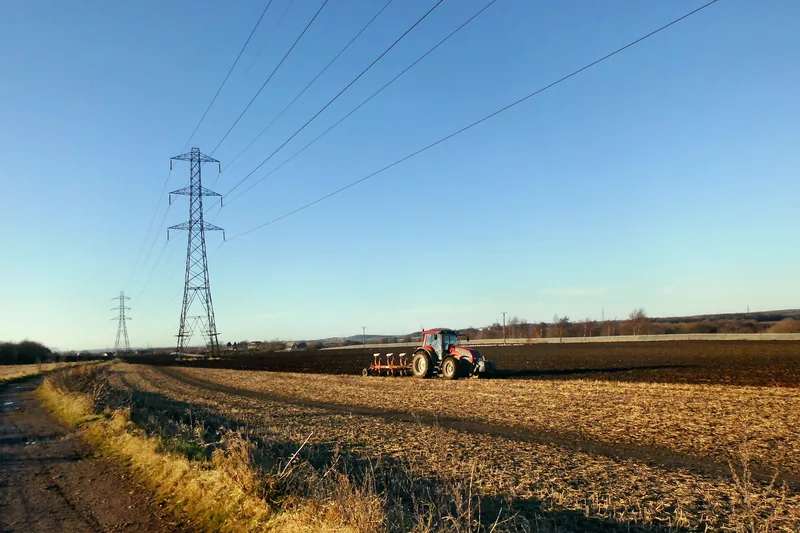
Myth. Horse ploughing ended as soon as tractors arrived.
Fact. It did not. Nelson Tamblin demonstrated a Wiltshire horse plough at the 1956 World Ploughing Championships, and horse ploughing matches are still photographed today.
Myth. The Festival of Britain models were toys.
Fact. They were scale models made for display in the Country Pavilion on the South Bank, “to communicate and visualise historical ploughing techniques,” shown “alongside examples of modern tractor technology.” [source]
Myth. All eight Festival models are still at The MERL, complete.
Fact. The Kent plough and Ley plough were later withdrawn from the collection. The whereabouts of the eighteenth-century plough “are not currently known.” Madeleine Ding writes that “the other five models still survive intact.” [source]
Myth. A caschrom is simply another name for a horse plough.
Fact. It is a hand-operated foot plough, taking its name from the Gaelic for “crooked foot,” used mainly in the Scottish Highlands on ground a drawn plough could not reach. [source]
Myth. A breast plough was pulled by a horse against the ploughman’s chest.
Fact. It was a manual tool. A T-shaped bar “pushed against the worker’s chest or thighs,” and a triangular blade sliced off the top layer of soil. [source]
Myth. A butterfly plough is a decorative pattern, not an implement.
Fact. The MERL’s Hornsby “butterfly,” or one-way reversible plough, has two mouldboards on a swivelling beam. At the end of the furrow a catch is released and the beam turns over. [source]
Myth. The Lister-Cockshutt arrived in Britain because Lister made ploughs in Ontario.
Fact. The Cockshutt Plow Company made it in Brantford, Ontario, in 1936. R. A. Lister & Co. of Dursley imported Cockshutt ploughs under a reciprocal agreement in which Cockshutt imported Lister cream separators. [source]
Myth. Steam ploughing engines drove up and down the furrows like tractors.
Fact. They usually stood at either side of the field and winched the plough to and fro on a cable, so the heavy engines did not have to walk the wet soil.
Myth. The Fordson was only faster than horses, not cheaper than steam.
Fact. The official MERL wording is that the mass-produced Fordson was “more compact and efficient than steam ploughing equipment, and faster than horse ploughing,” and “also cheaper than either of these options.” [source]
Myth. Nelson Tamblin’s first name is a later invention.
Fact. The Museum confirmed it in May 2015 with his great-nephew Rob Tamblin and his nephew Roger Tamblin. [source]
Myth. A ploughing-match photograph is a typical commercial working day.
Fact. Not automatically. Spectators are visible in the Muir Hill photograph at Ashby de la Launde; Major and Drummer were photographed at an East Sussex match; the Compton horses were at the 2011 Newbury & District Agricultural Society Ploughing Match.
Myth. The mouldboard is an ancient part of every plough, including the ard.
Fact. The addition of a mouldboard, in the medieval period, “represented a major improvement on the more ancient ard.” [source]
Enjoyed the furrow?
No pop-ups. No intrusive advertising. Just interesting stuff. A little support helps the next farmyard site get built.